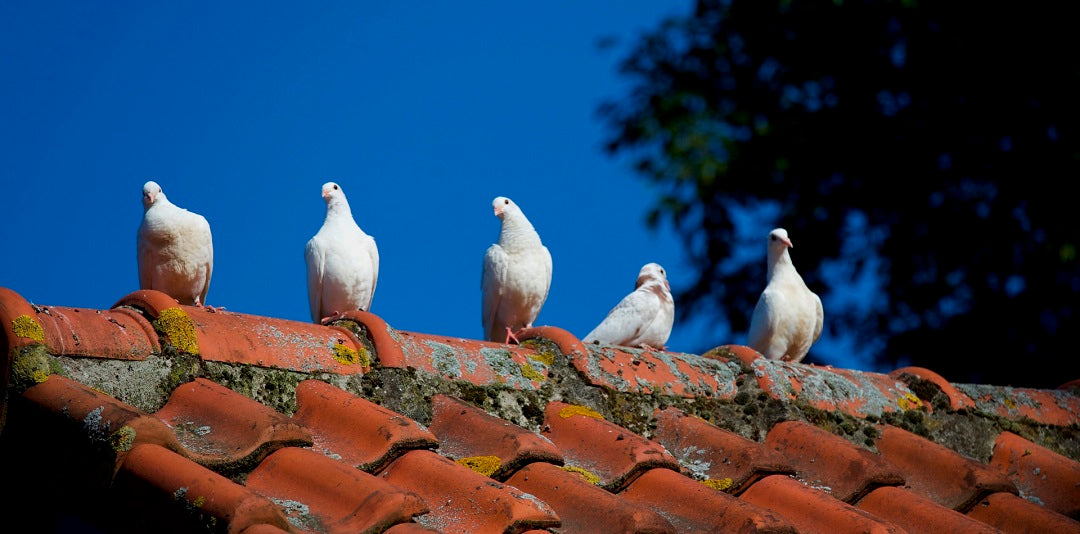
Pigeons are the bird species Flock Free is asked about more than any other, and they are among the hardest to move on. They are persistent, they are extremely prolific — a pair can raise up to six broods in a season — and once they have chosen a building they will work hard to stay there. Deter them from one ledge and they will often shift to another part of the same property, then drift back when conditions allow.
Below are the Flock Free products we recommend for pigeons. If you would rather understand the problem before choosing, the full guide continues underneath.
Shop Pigeon Control Products
LIQUID BIRD REPELLENTS

Flock Free Bird Repellent Spray - Ready-to-use Bird Deterrent
$21.99
No mixing. For small, defined areas.

Flock Free Bird Repellent Spray Concentrate, 32oz
$99.00
Mix your own for repeat treatment across several areas.

Flock Free Bird Repellent Concentrate, 1 gallon
$395.00
Volume concentrate for hazer, misting and sprayer programs.

InvisiDye UV Marker - 4 oz
$18.99
UV marker for the areas you have treated. Mix in or use on its own.
GELS & UV PAINT

Bird Proof® Gel – Sticky Bird Repellent Gel – 1 tube
$14.99
For shaded horizontal surfaces. Pair with UV Paint.

Flock Off UV Paint Clear 4 Ounce Dauber
$19.29
Clear to people, visible to birds. Used alongside gel and shock tape.

Surface Pro Tack – Liquid Spikes - Surface Protector - 4 fl.oz.
$24.99
A tacky film for landing points where spikes are impractical.
OZONE

Flock Free O3 Invisible Netting – Ozone Bird Repellent
$220.00
For covered areas such as undercrofts, canopies and loading docks. One unit treats up to 500 sq ft.
BIRD SPIKES

Stainless Steel Bird Spikes – 100 ft
$325.00
7.5 inch coverage, 2 ft sections. Parapets, wide ledges and beams.

Mini Spikes for Bird and Animal Control, 3-inches wide
$30.99
For narrow sills, signage tops and tighter runs.

Mini Spikes Bird Deterrent, 1” wide, roll of 49 ft
$259.00
The narrowest gauge, supplied as a 49 ft roll.
BIRD NETTING

Bird Netting High Tensile Black 3/4" Mesh 50' x 50'
$755.00
Full exclusion for courtyards, undercrofts and rooftop equipment areas.
HAZERS & AUTOMATED SYSTEMS

Moby - Portable Hazer
$3,249.00
Disperses repellent across a wide area. Portable between sites.

Tweet Zilla - Hazer
$4,899.00
Fixed commercial hazer for large buildings and roost areas.

SPECIALIZED DETERRENTS

Transparent Shock Tape 54 Foot Roll
$200.00
Low-profile ledge deterrent. Requires a charger.

110V Charger for Shock Tape and Hot Wire
$164.00
Powers a shock tape run where mains power is available.

HD Solar Charger for Hot Wire and Shock Tape
$334.00
Powers a shock tape run where there is no power nearby.

Seesaw Bird Deterrent System for Balconies, Ledges, Beams, etc. 3, 6, or 10 ft long
$28.99
For balconies, ledges and beams. 3, 6 and 10 ft lengths.

Scent Pucks for Bird Control
$22.99
Scent repellent pucks for dumpsters, storerooms and other enclosed spaces.

Flock Free Bird Bombs (5 pcs)
$41.99
Scent-repellent pods for small enclosed spaces. Repellent sold separately.

Flock Free Bird Bomb Bundle
$31.99
One Bird Bomb plus a 4 fl oz concentrate to soak it in.
Prices shown as listed at the time of publication. See each product page for current pricing and availability. Shipping restrictions apply to certain Flock Free Bird Repellent products in CT, IN, MD, MT, NM, RI, WI and DC — see the individual product page for current availability and shipping information. Other products on this page, including spikes, netting, shock systems, gels, UV paint and hazers, are not affected.
Not sure which of these fits your building? Call 732-987-5400 and we will talk it through — or keep reading below.
Continue Reading: How to Control Pigeons
Why Pigeons Become a Problem
Pigeons are not simply a nuisance in the abstract. They create specific, recurring problems for property owners and facility managers:
- Droppings. Accumulated droppings foul walkways, entrances, signage, vehicles and stock. They are acidic and, left in place, they stain and degrade the surfaces underneath.
- Nesting material. Nests built in gutters, downspouts, roof voids and equipment housings block drainage and interfere with rooftop equipment.
- Persistence. Because pigeons return to sites they have used before, an untreated problem tends to grow rather than resolve itself.
- Reputation. For retail, hospitality, food handling and commercial premises, visible bird activity and a soiled storefront affect how customers judge the business.
- Ongoing cleaning cost. Repeated pressure washing treats the symptom while the birds keep roosting overhead.
Where Pigeons Commonly Roost and Nest
Pigeons favor flat or near-flat surfaces with a clear approach, some shelter overhead, and a good view of the surroundings. Knowing where they are actually landing is what determines which control method is appropriate — so before choosing a product, walk the property and note exactly where the birds are.
- Ledges, sills and parapets — the classic landing surface, and the reason ledge products exist.
- Beams, joists and structural steel under canopies, loading docks and parking structures.
- Roof edges, ridges and rooftop equipment, including HVAC units and their supports.
- Signage — the gap behind an illuminated sign is sheltered, warm and hidden, which makes it prime nesting habitat.
- Balconies and railings on residential and mixed-use buildings.
- Open voids — courtyards, atriums, covered service areas, and any opening into a roof space.
Two distinctions matter when you survey. First, is this a perching site the birds pass through, or a roosting and nesting site they are committed to? Committed birds are far harder to move and usually need more than one method. Second, is the surface open to the weather or sheltered? Several products behave differently in direct sunlight, and that affects what will work where.
How to Control Pigeons
There is no single method that suits every surface on a building. The approaches below are the ones we recommend for pigeons, with the situations each is suited to.
Start by removing what attracts them
Before any product goes up, deal with the conditions. Remove nests as soon as they appear rather than after they are established, cut off access to food, and close the sheltered gaps that make a site comfortable. Every method below works better on a site that has been prepared this way, and some will underperform on a site that has not.
Bird netting — full exclusion
Netting is the most complete approach available. Rather than discouraging birds from landing, it physically denies access to the space altogether, which makes it the right answer for openings you want closed to pigeons: courtyards, covered service areas, loading docks, rooftop equipment areas, and the underside of canopies and roofs.
For pigeons, use a 3/4" mesh. Our high-tensile netting is available in 25' x 25' and 50' x 50'. Netting is the largest install on this page and it rewards careful measurement and proper tensioning — if you are covering a substantial opening, talk to us about specification and fixings before ordering.
Bird spikes — protecting ledges and landing surfaces
Spikes make a narrow surface impossible to stand on comfortably. They suit ledges, sills, parapets, beams and signage tops — anywhere the birds are landing rather than nesting in an enclosed space. They are visible up close, so they are usually a better fit for functional surfaces than for a decorative storefront.
Our Stainless Steel Bird Spikes – 100 ft cover a 7.5 inch width and come in 2 ft sections, fixed with adhesive or screws depending on the surface. For narrower ledges and tighter runs, Mini Spikes at 3 inches wide are the more proportionate choice. Match spike width to the ledge — a strip that leaves usable surface behind it simply moves the birds back a few inches rather than off the ledge.
Surface Pro Tack — a tacky surface treatment
Surface Pro Tack, our liquid alternative to spikes, leaves a tacky film that pigeons dislike standing on. It suits landing and nesting points where a mechanical spike is impractical or too visible — irregular surfaces, ornate stonework, and areas where appearance matters. Available in 4 fl.oz. for small runs and 1 gallon for larger areas.
Bird Proof Gel with Flock Off UV Paint
Bird Proof® Gel is applied to horizontal surfaces the birds are landing on. We pair it with Flock Off UV Paint — clear to the human eye, but visible to birds, which is what allows them to associate the marked area with a surface they would rather avoid. The paint is also available in a 1 gallon size for larger applications.
One important placement note from our own field guidance: use the gel and UV paint combination on horizontal surfaces that are protected from direct sunlight. Sheltered ledges, beams under canopies and covered walkways are where this pairing performs; fully exposed surfaces in strong sun are not the right application.
Shock systems
Shock tape delivers a mild, startling pulse when a bird lands, teaching pigeons that a surface is not worth returning to. It is low-profile compared with spikes, which makes it useful on exterior ledges and surfaces where you want the deterrent to stay visually discreet. As with the gel, we recommend combining it with UV Paint on external ledges so the birds can identify the treated area.
The system uses Transparent Shock Tape together with a charger — either the 110V Charger where power is available, or the HD Solar Charger where it is not.
Seesaw Bird Deterrent System
The Seesaw Bird Deterrent System is built for balconies, ledges and beams, and comes in 3, 6, and 10 ft lengths. It is worth considering on residential balconies and railings where spikes would be intrusive and where the run of surface to protect is well defined.
Bird repellent — the Tank Mix program
Our bird repellent is the one method on this page that treats an area rather than a single surface, and it is the product our own species guidance leans on most for pigeons. It is a plant-based formulation, exempt under FIFRA 25(b).
The repellent is applied regularly, and it works as a program rather than a one-off treatment: preparation and first treatment, reapplication over the following two weeks, then ongoing monthly maintenance. Skipping the reapplications is the most common reason a treatment is judged to have failed.
How you apply it depends on the size of the site:
- Handheld spraying for small and defined areas — the Ready-to-Use Bird Repellent Spray needs no mixing, while the 32oz concentrate and 1 gallon concentrate suit larger volumes.
- Misting for continuous coverage of a fixed area — see the Misting System.
- Hazers for large or commercial sites, dispersing the repellent through the air across a wide area. Options include the Tweet Zilla, the portable Moby, and the Mini Solar Hazer where power is limited.
Bird Bombs — spot treatment for enclosed spaces
Flock Free Bird Bombs are a scent repellent that gives you a long-lasting spot application. Each Bird Bomb is a highly absorbent pod designed to be saturated with Flock Free Bird Repellent, so it holds the treatment in place instead of you having to re-spray the same corner over and over.
They are straightforward to use. Soak the Bird Bomb in the repellent solution — the mix rate is 50% concentrate to 50% water — then place it wherever you need to deter birds. They mount easily with zip ties or any other fastener.
Where they earn their place is small, enclosed spaces: garbage cans, dumpsters, warehouses and small industrial facilities. On a pigeon job that usually means the trash enclosure, the dumpster corral or an interior corner of a warehouse — the spots where spraying is awkward and where the birds keep coming back for food. The Bird Bombs cause irritation that suppresses the birds’ desire to feed and creates a sense of danger in that space.
The 5-pack is supplied on its own and needs Flock Free Bird Repellent separately. If you would rather try one first, the Bird Bomb Bundle includes a single Bird Bomb together with a 4 fl oz bottle of concentrate to soak it in.
Choosing the Right Pigeon Control Method
Since 2007, Flock Free has been protecting properties, and the honest answer is that the building tells you what it needs — you just have to read it properly before you buy anything.
Start with where the birds actually are. A narrow ledge with pigeons lined along it is a spikes or Surface Pro Tack job. An open courtyard or a canopy they keep flying into wants netting, because you are trying to close the space rather than argue over one surface. And when the activity is spread across a whole roof or yard rather than concentrated on a couple of perches, that is when the repellent program starts to make more sense than any single fixture.
Then ask what they are doing there. Birds that drop in during the day and move on will usually give up after one well-chosen product. Birds that are roosting overnight or sitting on nests are committed, and committed pigeons almost always need a combination — plus somebody clearing nests as they appear, or you are just resetting the same problem every few weeks.
The surface matters more than people expect. Whether a ledge sits in full sun or under cover decides whether the gel and UV paint pairing is right at all. What the ledge is made of decides whether spikes go down with adhesive or screws. And on a storefront or anything customer-facing, how the fix looks is a real consideration, not a vanity one — that is usually where Surface Pro Tack wins over a visible spike strip.
Finally, be realistic about scale. Protecting a single balcony is a different job from a warehouse roof or a food plant, in method and in how the work gets applied. Most properties of any size end up running two or three things together: exclusion where the space can be closed, ledge protection where the birds land, and the repellent program across everything else — because a pigeon moved off one surface will simply try the next one along.
If you are weighing it up and would rather talk to someone who has seen your kind of building before, call us on 732-987-5400.
Related Bird Control Resources
- Bird Control Tips by Species of the Birds — our guidance across the other bird species we treat.
- Bird Spikes — the full range of spike products.
- Bird Netting and Accessories — netting, fixings and installation components.
- Liquid Products — the bird repellent range.
- UV Paints and Gels — Flock Off UV Paint and Bird Proof Gel.
- Shock Systems — shock tape, connectors and chargers.
- Hazers and Sprayers — application equipment for the repellent program.
- Commercial Bird Control Services — for larger sites and managed programs.
Shop by Bird
Flock Free guidance for the other species we treat: