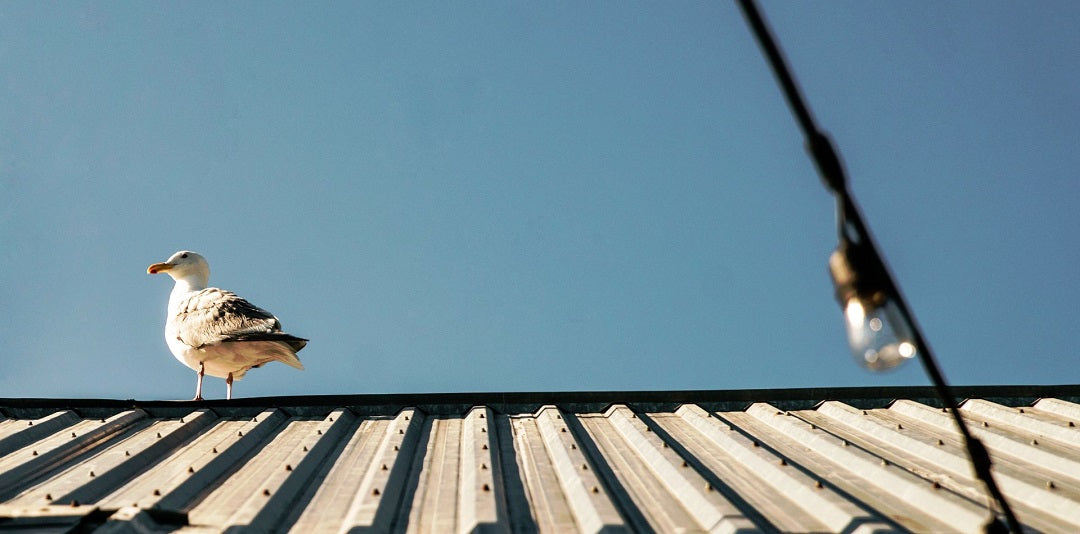
Gulls are intelligent, highly persistent and unusually bold around people. They cause real damage at fish farms, industrial sites, ports and marinas, on boats and on commercial roofs, and in coastal areas they will approach diners directly for food. They respond well to a site being made uncomfortable and will move off — but they keep testing, and they come back whenever the conditions that suited them return.
Below are the Flock Free products we recommend for gulls. If you would rather understand the problem before choosing, the full guide continues underneath.
Shop Seagull Control Products
LIQUID BIRD REPELLENTS

Flock Free Bird Repellent Spray - Ready-to-use Bird Deterrent
$21.99
No mixing. For small, defined areas.

Flock Free Bird Repellent Concentrate, 1 gallon
$395.00
Volume concentrate for hazer, misting and sprayer programs.
GELS & UV PAINT

Surface Pro Tack – Liquid Spikes - Surface Protector - 4 fl.oz.
$24.99
A tacky film for landing surfaces where spikes are impractical.
BIRD SPIKES

Stainless Steel Bird Spikes – 100 ft
$325.00
7.5 inch coverage for parapets, wide ledges and roof edges.
HAZERS & AUTOMATED SYSTEMS


Tweet Zilla - Hazer
$4,899.00
Fixed commercial hazer for ports, plants and large roofs.
SPECIALIZED DETERRENTS

Seagull Effigy
$119.00
A decoy named for the species. Placed where gulls loaf and nest.

Seagull Stopper – Bird Deterrent System for Boat Hoist Canopies
4-post $199.95 · 6-post $299.95
Posts and lines over a boat hoist canopy break up the surface gulls land on.

Transparent Shock Tape 54 Foot Roll
$200.00
Low-profile deterrent for roof edges, beams and ledges.

110V Charger for Shock Tape and Hot Wire
$164.00
Charger to run a shock tape run where power is available.

HD Solar Charger for Hot Wire and Shock Tape
$334.00
Powers a shock tape run on roofs and waterside sites with no power nearby.

Flock Free Bird Bombs (5 pcs)
$41.99
Scent-repellent pods for small enclosed spaces. Repellent sold separately.

Flock Free Bird Bomb Bundle
$31.99
One Bird Bomb plus a 4 fl oz concentrate to soak it in.
Prices shown as listed at the time of publication. See each product page for current pricing and availability. Shipping restrictions apply to certain Flock Free Bird Repellent products in CT, IN, MD, MT, NM, RI, WI and DC — see the individual product page for current availability and shipping information. Other products on this page are not affected.
Not sure which of these fits your site? Call 732-987-5400 and we will talk it through — or keep reading below.
Continue Reading: How to Control Seagulls
Why Gulls Become a Problem
- Roof fouling. Gulls loaf and nest on flat and low-pitch commercial roofs, and the volume of droppings degrades the roof surface and blocks drainage.
- Food premises and waste. Anywhere food is stored, served or discarded attracts them, which is why restaurants, food plants and waste handling sites see the worst of it.
- Boldness around people. In coastal and tourist areas gulls will take food directly from customers, which becomes a service and safety problem rather than just a mess.
- Ports, marinas and boats. Masts, decks, docks and moored vessels all provide the open perches gulls prefer.
- Aquaculture. Fish farms are a direct loss rather than a nuisance.
Where Gulls Land and Nest
- Flat and low-pitch roofs, especially with parapets and rooftop equipment for shelter.
- Roof edges, ridges and parapet walls used as lookout perches.
- Beams, pipework and canopies on industrial structures.
- Masts, rigging, docks and decking at marinas.
- Near food storage, kitchens and waste disposal points.
Why gulls keep coming back
Gulls are quick to learn and quick to return. They will read a site accurately: if the food source is still there, or a treated ledge simply pushes them to an untreated one twenty feet away, they will adapt rather than leave. Treating the whole area they use — and dealing with the food that drew them — is what changes the outcome.
How to Control Gulls
Start with food and waste
On gull sites this matters more than on almost any other species. Bins, waste compaction areas, grease stores, spillage points and open food service all sustain the birds regardless of what is fitted to the roof. Our own guidance is explicit that repellent treatment should concentrate on the surfaces around food storage and waste disposal.
The Seagull Effigy
The Seagull Effigy is one of the few products in our range named for a single species. It is placed where gulls loaf or nest and works on their reaction to a distressed bird of their own kind. Placement, height and how long it is left in position all affect how well it performs — if you are unsure, ask us rather than guessing.
Ledge and surface protection
For roof edges, parapets and beams where gulls land, the practical options are Stainless Steel Bird Spikes for wider surfaces and Surface Pro Tack where a mechanical spike is impractical or too visible. Gulls are large birds, so spike coverage needs to match the full usable width of the ledge rather than a strip of it.
Shock systems
Shock tape gives a mild, startling pulse when a bird lands and stays visually discreet, which suits long roof edges and exposed ledges. It uses Transparent Shock Tape with either the 110V Charger where power is available or the HD Solar Charger where it is not.
Bird repellent applied by hazer, misting or sprayer
The Flock Free bird repellent treats an area rather than a single surface, which is what large roofs and open industrial sites need. It is a plant-based formulation, exempt under FIFRA 25(b), applied as a program: preparation and first treatment, reapplication over the following two weeks, then monthly maintenance.
Use the Ready-to-Use spray for small defined areas, or the 1 gallon concentrate through a portable Moby hazer, a fixed Tweet Zilla or a Misting System on larger sites. Concentrate the treatment where food and waste are handled.
Bird Bombs — spot treatment for enclosed spaces
Flock Free Bird Bombs are a scent repellent that gives you a long-lasting spot application. Each Bird Bomb is a highly absorbent pod designed to be saturated with Flock Free Bird Repellent, so the treatment stays put instead of needing to be re-sprayed.
Soak the Bird Bomb in the repellent solution — the mix rate is 50% concentrate to 50% water — then place it wherever you need to deter birds. They mount easily with zip ties or any other fastener.
They are designed for small, enclosed spaces: garbage cans, dumpsters, warehouses and small industrial facilities. On a gull site that usually means the waste enclosure, the dumpster area or the food store — the enclosed spots where the birds keep coming back and where spraying is awkward. The Bird Bombs cause irritation that suppresses the birds’ desire to feed and creates a sense of danger in that space.
The 5-pack is supplied on its own and needs Flock Free Bird Repellent separately. The Bird Bomb Bundle includes a single Bird Bomb with a 4 fl oz bottle of concentrate to soak it in.
Choosing the Right Approach
With gulls the first question is nearly always about food. If there is an open dumpster, a grease store or outdoor food service on the site, that is where the problem starts, and no amount of hardware on the roof will settle it while the reward is still there. Deal with that first and everything else you do works better.
After that, look at whether the birds are loafing or nesting. Gulls dropping onto a roof between feeds will usually give up once the surface is treated. Gulls that are nesting are committed, they get defensive, and the timing of any work becomes a real consideration.
The structure decides the rest. Long roof edges and parapets suit shock tape, which stays discreet across a big run. Wide ledges and beams take spikes — and because gulls are large birds, the spikes have to cover the whole usable width, not a strip down the middle. Awkward profiles and anything visible from the street are where Surface Pro Tack tends to win. Exposed coastal sites bring their own problem: wind affects what stays put and how treatment is applied.
Most gull sites end up combining ledge protection where the birds land with a maintained repellent program over the wider roof. Since 2007, Flock Free has been protecting commercial, coastal and industrial properties — if you would rather talk it through first, call 732-987-5400.
Related Bird Control Resources
- Bird Control Tips by Species of the Birds — our guidance across the other species we treat.
- Bird Spikes — the full range of spike products.
- Shock Systems — shock tape, connectors and chargers.
- Liquid Products — the bird repellent range.
- Hazers and Sprayers — application equipment.
- Visual Deterrents — including the Seagull Effigy.
- Commercial Bird Control Services — for larger sites and managed programs.
Shop by Bird
Flock Free guidance for the other species we treat: